
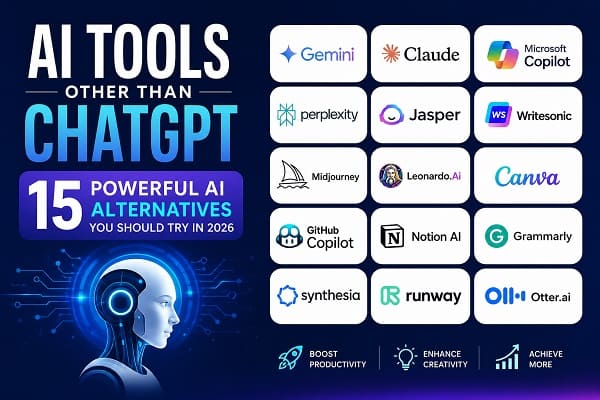
Artificial intelligence has become an essential part of modern life. From writing blog posts and generating images to analyzing data and automating workflows, AI tools are helping individuals and businesses work smarter than ever before. While ChatGPT remains one of the most popular AI assistants available today, it is far from the only option.
In fact, many users are now searching for AI tools other than ChatGPT because they need specialized features, better integrations, stronger research capabilities, advanced image generation, or AI solutions tailored to specific industries.
The AI landscape has evolved rapidly over the past few years. New platforms are emerging that focus on everything from content creation and coding assistance to video production and business automation. Some of these tools even outperform ChatGPT in certain tasks, making them valuable additions to your productivity toolkit.
Whether you’re a blogger looking for better writing assistance, a developer searching for coding support, a designer seeking AI-powered image generation, or a business owner wanting workflow automation, there is an AI tool designed specifically for your needs.
In this comprehensive guide, we’ll explore the best AI tools other than ChatGPT, explain what makes them unique, compare their strengths and weaknesses, and help you determine which solution is right for you.
Why Look for AI Tools Other Than ChatGPT?
ChatGPT is undoubtedly one of the most versatile AI assistants available, but no single tool can excel at every task. Different AI platforms are designed with different objectives in mind.
For example:
- Some AI tools specialize in content writing and SEO.
- Others focus on research and fact-checking.
- Certain platforms are built specifically for developers.
- Some excel at image and video generation.
- Others are designed for team collaboration and productivity.
By exploring ChatGPT alternatives, users can access specialized features that may better suit their goals.
Benefits of using multiple AI tools include:
- Improved productivity
- Better content creation
- Enhanced research capabilities
- More creative design options
- Faster coding assistance
- Better workflow automation
- Access to real-time information
Let’s explore the top AI tools that are making waves in 2026.
1. Google Gemini
Google Gemini is widely regarded as one of the strongest competitors to ChatGPT. Developed by Google DeepMind, Gemini combines advanced conversational AI with Google’s vast ecosystem of products and services.
Unlike traditional AI chatbots that rely solely on pre-trained data, Gemini can access current information from the internet. This means users can receive up-to-date answers about news, technology, business trends, and emerging topics.
One of Gemini’s biggest advantages is its deep integration with Google Workspace. Users can interact with Gmail, Google Docs, Google Drive, Sheets, and other Google applications directly through the AI assistant.
Key Features
- Real-time web access
- Integration with Google Workspace
- Multimodal capabilities
- Document analysis
- Image understanding
- Advanced reasoning
Real-World Applications
Students can upload lecture notes and request summaries.
Researchers can analyze academic papers and extract insights.
Business professionals can draft reports, summarize meetings, and organize information across Google Workspace.
Content creators can brainstorm article ideas, create outlines, and perform topic research quickly.
Advantages
Google Gemini provides access to current information, making it ideal for research-heavy tasks. Its integration with Google’s ecosystem creates a seamless workflow for millions of users worldwide.
Limitations
While Gemini is highly capable, some advanced features are restricted to premium plans. Additionally, creative writing output may occasionally feel less natural compared to some competitors.
Best For
- Students
- Researchers
- Business professionals
- Content creators
- Google Workspace users
2. Claude AI
Claude AI, developed by Anthropic, has emerged as one of the most respected AI assistants available today. Many users consider Claude to be one of the best AI tools other than ChatGPT because of its exceptional writing quality and advanced reasoning abilities.
Claude is particularly well-known for handling large amounts of information. It can process lengthy reports, books, contracts, and research papers while maintaining context throughout the conversation.
This capability makes it especially useful for professionals who work with extensive documentation.
Key Features
- Large context window
- Advanced reasoning
- Long-form writing assistance
- Document analysis
- Natural conversation flow
- Strong summarization capabilities
Real-World Applications
A lawyer can upload contracts and request key clause summaries.
A blogger can generate detailed article drafts and content outlines.
A researcher can analyze lengthy academic papers and extract important findings.
A consultant can review business reports and identify opportunities for improvement.
Advantages
Claude excels at producing well-structured, human-like writing. Many users prefer it for long-form content because it tends to maintain coherence better across lengthy documents.
Limitations
Claude offers fewer third-party integrations compared to some competitors. Certain advanced features may also require a paid subscription.
Best For
- Writers
- Researchers
- Consultants
- Legal professionals
- Business analysts
3. Microsoft Copilot
Microsoft Copilot is transforming workplace productivity by embedding artificial intelligence directly into the Microsoft ecosystem. Rather than functioning solely as a chatbot, Copilot acts as an intelligent assistant across Microsoft applications such as Word, Excel, Outlook, Teams, and PowerPoint.
This integration allows users to automate repetitive tasks and improve efficiency across their daily workflows.
Key Features
- Word document generation
- Excel data analysis
- PowerPoint presentation creation
- Outlook email drafting
- Teams meeting summaries
- Workflow automation
Real-World Applications
Business professionals can generate reports in Word within minutes.
Data analysts can uncover trends and insights from large Excel spreadsheets.
Managers can summarize meetings and create action plans automatically.
Marketing teams can create presentations and campaign reports more efficiently.
Advantages
Microsoft Copilot significantly reduces the time required to complete common office tasks. Organizations already using Microsoft 365 often experience immediate productivity gains.
Limitations
The platform works best within the Microsoft ecosystem, and advanced enterprise features may require additional licensing.
Best For
- Corporate teams
- Office workers
- Project managers
- Executives
- Students
4. Perplexity AI
Perplexity AI has quickly become one of the most trusted AI-powered research tools on the internet. Unlike many AI assistants that simply generate responses, Perplexity provides citations and references to support its answers.
This transparency makes it particularly valuable for students, journalists, academics, and professionals who require verifiable information.
Key Features
- Source-backed answers
- Real-time internet search
- Research-focused responses
- Citation support
- Fast information retrieval
- Follow-up questioning
Real-World Applications
Students can conduct academic research more efficiently.
Journalists can verify facts and gather sources quickly.
Business professionals can monitor industry trends and market developments.
Content creators can research topics before writing articles.
Advantages
Perplexity’s citation-based approach increases trust and allows users to verify information independently.
Limitations
It is less focused on creative writing and storytelling compared to some AI chatbots.
Best For
- Researchers
- Journalists
- Students
- Academics
- Professionals
5. Jasper AI
Jasper AI is one of the most popular AI-powered writing platforms designed specifically for marketers, businesses, agencies, and content creators. Unlike general-purpose AI chatbots, Jasper focuses heavily on creating marketing content that drives engagement and conversions.
Many companies use Jasper to generate blog posts, product descriptions, email campaigns, social media content, advertising copy, and landing pages. The platform is particularly valuable for businesses that need to produce large volumes of content consistently.
One of Jasper’s most powerful features is its Brand Voice capability. This allows businesses to train the AI to write in a specific style and tone, ensuring consistency across all marketing channels.
Key Features
- Long-form blog writing
- Marketing copy generation
- Brand voice customization
- SEO-friendly content creation
- Social media content generation
- Team collaboration tools
Real-World Applications
Digital marketers can generate ad campaigns in minutes.
E-commerce stores can create hundreds of product descriptions quickly.
Bloggers can accelerate content production while maintaining quality.
Marketing agencies can serve more clients without increasing workload.
Advantages
- Excellent marketing-focused content
- Consistent brand messaging
- User-friendly interface
- Time-saving automation
Limitations
- Premium pricing can be expensive for beginners
- Less effective for highly technical research
Best For
- Marketing agencies
- Bloggers
- E-commerce businesses
- Content marketers
- Small business owners
6. Writesonic
Writesonic is another powerful AI writing platform that has become increasingly popular among bloggers and digital marketers. It combines content generation with SEO optimization, making it particularly useful for website owners looking to improve search rankings.
Unlike many AI writing assistants, Writesonic offers tools specifically designed for SEO-focused content creation. Users can generate articles, landing pages, advertisements, and product descriptions optimized for search engines.
Key Features
- AI article generation
- SEO content assistance
- Landing page creation
- Product descriptions
- Ad copy generation
- Content rewriting
Real-World Applications
Affiliate marketers can create review articles faster.
Businesses can generate website copy for new products.
Bloggers can scale content production.
Freelancers can increase productivity and client output.
Advantages
- SEO-focused writing tools
- Multiple content templates
- Easy-to-use dashboard
- Fast content generation
Limitations
- May require manual editing
- Premium features locked behind subscriptions
Best For
- Bloggers
- Affiliate marketers
- Freelance writers
- Small businesses
7. Midjourney
Midjourney is widely regarded as one of the best AI image generators available today. It transforms simple text prompts into stunning visual artwork, often producing results that rival professional digital artists.
Unlike ChatGPT, which focuses on text generation, Midjourney specializes entirely in image creation. Artists, designers, marketers, and content creators use it to create illustrations, product mockups, concept art, book covers, and social media graphics.
Its ability to generate highly detailed, creative, and visually appealing images has made it a favorite among creative professionals worldwide.
Key Features
- Text-to-image generation
- Artistic image styles
- High-resolution outputs
- Creative design assistance
- Concept art generation
Real-World Applications
Designers can create concept artwork.
Authors can generate book cover ideas.
Businesses can create unique marketing visuals.
Content creators can produce engaging social media graphics.
Advantages
- Exceptional image quality
- Highly creative results
- Wide variety of artistic styles
Limitations
- Learning curve for prompt writing
- Primarily focused on image generation
Best For
- Graphic designers
- Artists
- Content creators
- Marketing professionals
8. Leonardo AI
Leonardo AI is one of the fastest-growing AI image generation platforms and has become a favorite among creators looking for more customization and control.
The platform is particularly popular among game developers because it allows users to create characters, assets, environments, and concept art efficiently.
Unlike some AI image tools that prioritize simplicity, Leonardo AI offers advanced customization options that appeal to professional creators.
Key Features
- AI image generation
- Custom model training
- Asset creation
- Character design
- Creative artwork generation
Real-World Applications
Game developers can create game assets.
Designers can generate visual concepts.
Businesses can produce unique marketing graphics.
Artists can experiment with new styles and ideas.
Advantages
- High-quality image generation
- Advanced customization
- Free plan available
- Professional-grade outputs
Limitations
- Some advanced features require paid plans
Best For
- Game developers
- Digital artists
- Designers
- Creative professionals
9. Canva AI
Canva AI has transformed graphic design by making professional-quality design accessible to everyone. The platform combines traditional design tools with powerful artificial intelligence features.
Users can create presentations, social media graphics, logos, videos, posters, and marketing materials without requiring professional design experience.
Key Features
- AI image generation
- Magic Design
- Magic Write
- Presentation creation
- Social media content design
Real-World Applications
Small businesses can design marketing materials.
Teachers can create engaging presentations.
Content creators can build social media graphics quickly.
Entrepreneurs can design branding assets.
Advantages
- Beginner-friendly
- Extensive template library
- Affordable pricing
- All-in-one design platform
Limitations
- Advanced designers may prefer specialized tools
Best For
- Small businesses
- Students
- Content creators
- Entrepreneurs
10. GitHub Copilot
GitHub Copilot is one of the most useful AI tools for developers. Created through a partnership between GitHub and OpenAI, it acts as an intelligent coding assistant that helps programmers write code faster and more accurately.
Copilot can suggest code snippets, complete functions, generate boilerplate code, and even explain complex programming concepts.
Key Features
- AI-powered code completion
- Code generation
- Bug detection assistance
- Programming support
- Multi-language support
Real-World Applications
Developers can reduce coding time.
Students can learn programming faster.
Teams can accelerate software development projects.
Advantages
- Significant productivity boost
- Supports multiple languages
- Seamless IDE integration
Limitations
- Suggestions still require review
- Subscription required for full access
Best For
- Software developers
- Students
- Engineering teams
11. Notion AI
Notion AI combines artificial intelligence with productivity management. It helps users organize projects, manage tasks, summarize documents, and create content inside the Notion workspace.
Key Features
- Task management
- Content summarization
- Note generation
- Workflow automation
- Knowledge management
Best For
- Entrepreneurs
- Students
- Teams
- Project managers
12. Grammarly AI
Grammarly AI has evolved from a grammar-checking tool into a complete writing assistant. It helps users improve clarity, tone, engagement, and professionalism in their writing.
Key Features
- Grammar correction
- Tone analysis
- AI content generation
- Writing enhancement
- Email drafting
Best For
- Writers
- Professionals
- Students
- Business users
13. Synthesia
Synthesia allows users to create professional AI-generated videos without cameras, microphones, or actors.
Businesses use Synthesia to produce training videos, tutorials, presentations, and marketing content quickly and cost-effectively.
Key Features
- AI avatars
- Video generation
- Multi-language support
- Professional presentations
Best For
- Educators
- Businesses
- Marketing teams
14. Runway AI
Runway AI is revolutionizing video production by allowing creators to generate and edit videos using artificial intelligence.
Key Features
- AI video generation
- Background removal
- Motion tracking
- Creative video effects
Best For
- Video creators
- YouTubers
- Marketing teams
15. Otter AI
Otter AI specializes in meeting transcription and note-taking. It automatically records conversations, generates transcripts, and creates summaries.
Key Features
- Real-time transcription
- Meeting summaries
- Speaker identification
- Team collaboration
Best For
- Remote teams
- Business professionals
- Students
Frequently Asked Questions (FAQ)
What are the best AI tools other than ChatGPT?
Some of the best AI tools other than ChatGPT include Google Gemini, Claude AI, Microsoft Copilot, Perplexity AI, Jasper AI, Midjourney, Leonardo AI, Canva AI, GitHub Copilot, and Notion AI.
Which AI tool is best for content writing?
Claude AI, Jasper AI, and Writesonic are among the best AI writing tools for creating blogs, articles, marketing copy, and business content.
Which AI tool is best for image generation?
Midjourney and Leonardo AI are considered two of the most powerful AI image generators available today.
Are there free AI tools other than ChatGPT?
Yes. Google Gemini, Claude AI, Perplexity AI, Canva AI, Leonardo AI, and Microsoft Copilot all offer free plans with useful features.
Which AI tool is best for students?
Students often benefit most from Google Gemini, Claude AI, Perplexity AI, Grammarly AI, and Notion AI because of their research, writing, and productivity capabilities.
