
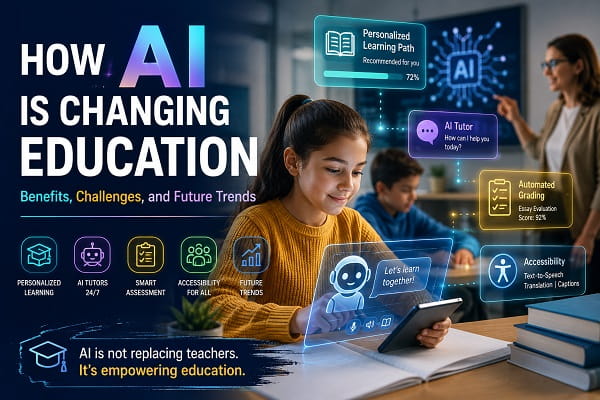
A student struggling with algebra can now receive step-by-step explanations from an AI tutor at midnight. A teacher with hundreds of assignments to grade can use artificial intelligence to automate repetitive tasks. A visually impaired learner can access educational content through AI-powered accessibility tools. Meanwhile, researchers, universities, and technology companies are investing billions of dollars into AI-driven learning systems.
Education is undergoing one of the biggest transformations in modern history.
Artificial intelligence is no longer a futuristic concept discussed only in technology conferences. It is already influencing classrooms, online learning platforms, universities, and workplace training programs around the world.
Supporters believe AI can make education more personalized, accessible, and effective. Critics worry about overreliance on technology, academic dishonesty, and the potential loss of essential human skills.
So what is really happening?
How is AI changing education today, and what could classrooms look like in the coming years?
Let’s explore the benefits, challenges, and future trends shaping the next generation of learning.
The Rise of AI in Education
For decades, educational technology focused on digitizing traditional learning.
Students moved from paper textbooks to digital textbooks.
Classrooms adopted projectors, laptops, tablets, and online learning systems.
Artificial intelligence represents a much bigger shift.
Instead of simply delivering information, AI systems can:
- Analyze student performance
- Adapt lessons to individual needs
- Provide instant feedback
- Generate educational content
- Assist teachers with administrative tasks
- Support personalized learning experiences
This ability to adapt and respond dynamically is what makes AI different from previous educational technologies.
Why Schools and Universities Are Embracing AI
Education faces several long-standing challenges:
- Large class sizes
- Teacher shortages
- Learning gaps
- Administrative workload
- Limited personalization
- Accessibility barriers
AI offers potential solutions to many of these problems.
Rather than replacing teachers, most educational institutions are exploring ways AI can support educators and improve student outcomes.
This explains why schools, universities, and online learning platforms are increasingly investing in AI-powered tools.
Personalized Learning: One of AI’s Biggest Advantages
Traditional classrooms often require one teacher to instruct dozens of students at the same pace.
The problem is obvious.
Not every student learns the same way.
Some learners grasp concepts quickly.
Others need additional explanations and practice.
AI can help bridge this gap through personalized learning.
How It Works
AI systems can analyze:
- Quiz results
- Assignment performance
- Learning speed
- Common mistakes
- Subject strengths
- Knowledge gaps
Based on this information, educational platforms can recommend customized lessons and exercises.
Why It Matters
Imagine two students studying mathematics.
One struggles with fractions.
The other excels in fractions but has difficulty with geometry.
Instead of forcing both students through the same lessons, AI can tailor learning paths based on individual needs.
This creates a more efficient and engaging educational experience.
AI Tutors Are Available 24/7
One of the most significant educational developments is the rise of AI tutoring.
Unlike human tutors, AI assistants are available at any time.
Students can ask questions:
- Early in the morning
- Late at night
- During weekends
- While studying independently
This constant availability helps learners receive support whenever they need it.
Many students now use AI assistants as study companions, helping them understand difficult concepts and organize research more efficiently. If you’re evaluating the leading AI assistants available today, read our detailed ChatGPT vs Claude comparison.
Examples of AI Tutoring Tasks
AI can assist with:
- Explaining concepts
- Solving practice problems
- Reviewing essays
- Generating quizzes
- Summarizing lessons
- Providing study plans
While AI cannot replace experienced teachers, it can provide valuable supplemental support.
AI Is Reducing Administrative Work for Teachers
Teaching involves far more than classroom instruction.
Educators spend countless hours:
- Grading assignments
- Creating lesson plans
- Preparing assessments
- Writing reports
- Managing student records
These responsibilities consume time that could otherwise be spent teaching.
How AI Helps
Modern AI tools can:
- Generate quiz questions
- Create lesson outlines
- Draft educational materials
- Analyze student performance data
- Automate repetitive tasks
This allows teachers to focus more on student engagement and instruction.
Improved Accessibility for Students
Education should be available to everyone.
Unfortunately, barriers still exist for many learners.
AI is helping make learning more accessible.
Accessibility Improvements Include
Real-Time Transcription
Students can convert spoken lectures into written text.
Text-to-Speech Technology
Educational materials can be read aloud.
Speech Recognition
Students can interact using voice commands.
Language Translation
AI can translate content into multiple languages.
Visual Assistance
Image recognition tools can describe visual content.
These innovations help create more inclusive learning environments.
AI-Powered Content Creation
Teachers and educational organizations create enormous amounts of content.
AI can assist by generating:
- Lesson plans
- Worksheets
- Practice tests
- Presentation slides
- Discussion questions
- Learning activities
This doesn’t eliminate the teacher’s role.
Instead, it reduces preparation time and allows educators to refine rather than create everything from scratch.
The Impact of AI on Online Learning
Online learning has expanded dramatically over the last decade.
AI is accelerating this trend.
Modern learning platforms can now:
- Recommend courses
- Track progress
- Suggest study materials
- Identify struggling students
- Personalize learning journeys
As a result, online education is becoming increasingly sophisticated.
Students can receive experiences that feel more tailored than traditional one-size-fits-all approaches.
How Students Are Using AI Today
Taking effective notes remains one of the most important study skills, even in the age of artificial intelligence. Explore our guide to the best AI note-taking apps for students and professionals to discover tools that can improve productivity and organization.
Students are adopting AI faster than many institutions expected.
Common uses include:
Research Assistance
Students use AI to understand complex topics quickly.
Study Guides
AI can generate summaries and revision materials.
Brainstorming Ideas
Learners often use AI to explore essay topics and project ideas.
Language Learning
AI can assist with vocabulary, grammar, and conversation practice.
Coding Help
Programming students frequently use AI to understand concepts and debug code.
The key challenge is ensuring these tools support learning rather than replace critical thinking.
The Growing Concern About Academic Integrity
While AI offers significant benefits, it also creates challenges.
Perhaps the most discussed issue is academic honesty.
Common Concerns
Students may use AI to:
- Write essays
- Complete homework
- Solve assignments
- Generate reports
without fully understanding the material.
This raises important questions.
If an AI writes the assignment, what has the student actually learned?
Educational institutions are still developing policies to address this issue.
Can AI Replace Teachers?
This is one of the most common questions.
The short answer is no.
At least not anytime soon.
Teaching involves far more than delivering information.
Great educators provide:
- Motivation
- Emotional support
- Mentorship
- Classroom management
- Human connection
- Critical thinking development
AI excels at processing information.
Teachers excel at understanding people.
The most likely future involves collaboration rather than replacement.
Challenges Schools Must Address
Despite its potential, AI adoption is not without risks.
Privacy Concerns
Educational systems collect large amounts of student data.
Protecting this information is essential.
Bias in AI Systems
AI models can sometimes reflect biases found in their training data.
Technology Access Gaps
Not all students have equal access to devices and internet connections.
Overdependence on Technology
Students may become too reliant on AI tools.
Accuracy Problems
AI occasionally produces incorrect or misleading information.
Educators must teach students how to verify information independently.
The Future of AI in Education
Video-based learning continues to grow in popularity, and artificial intelligence is making educational video production easier than ever. Our guide to the best AI video generators explores some of the most powerful tools available today.
The next decade could bring even more dramatic changes.
Emerging trends include:
Intelligent Learning Platforms
Systems that adapt continuously to student performance.
AI Learning Companions
Personalized educational assistants that follow students throughout their academic journey.
Immersive Learning Experiences
Combining AI with virtual reality and augmented reality.
Predictive Learning Analytics
Identifying struggling students before problems become severe.
Automated Content Generation
Rapid creation of educational resources tailored to specific needs.
These developments could fundamentally reshape how knowledge is delivered and consumed.
What Students Should Learn in the AI Era
As AI becomes more capable, some skills become even more valuable.
Future learners should focus on:
Critical Thinking
Evaluating information and making informed decisions.
Creativity
Generating original ideas and solutions.
Communication
Expressing ideas clearly and effectively.
Problem Solving
Addressing complex challenges.
Digital Literacy
Understanding how technology works and how to use it responsibly.
The goal is not to compete with AI but to work alongside it effectively.
What Educators Should Focus On
Teachers who embrace AI strategically may gain significant advantages.
Instead of resisting technology, educators can focus on:
- Guiding students
- Encouraging critical thinking
- Evaluating AI-generated information
- Teaching ethical technology use
- Building human-centered learning environments
The teacher’s role may evolve, but it remains essential.
Artificial intelligence is influencing far more than classrooms and universities. If you’re curious about how AI is reshaping careers and everyday life, learn how to prepare for artificial intelligence and build skills for the future.
A New Chapter for Education
Artificial intelligence is transforming education in ways that were difficult to imagine just a few years ago.
Students now have access to personalized tutoring, instant feedback, adaptive learning systems, and powerful educational tools that can support learning around the clock.
At the same time, schools must address challenges related to academic integrity, privacy, accessibility, and responsible AI use.
The future of education will likely be shaped not by humans or AI alone, but by effective collaboration between the two.
The institutions that learn how to balance technology with human expertise will be best positioned to prepare students for a rapidly changing world.
As AI continues to evolve, one thing is becoming increasingly clear: education is entering a new era, and the way we learn may never be the same again.
