
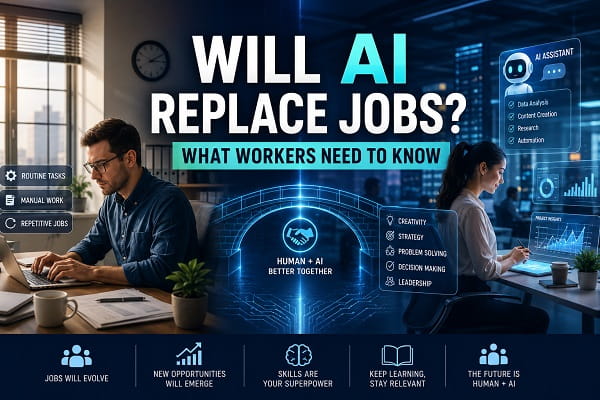
A few years ago, artificial intelligence was mostly a topic for researchers, science fiction movies, and technology enthusiasts. Today, AI can write articles, generate images, create videos, analyze data, answer customer questions, write software code, and even assist with medical research.
As these capabilities continue to improve, a question that once seemed hypothetical has become increasingly urgent:
Will AI replace jobs?
It’s a question being asked by students planning their careers, professionals worried about job security, business leaders exploring automation, and governments trying to prepare for economic change.
The answer isn’t as simple as “yes” or “no.”
AI is already changing the job market, but the reality is far more complex than many headlines suggest.
Some jobs will be heavily affected. Some roles will evolve. New careers will emerge. And many professions will continue to rely on uniquely human skills that AI cannot easily replicate.
Understanding what’s actually happening is far more useful than believing either the extreme optimism or the extreme fear often found online.
Why People Are Worried About AI
Every major technological revolution has raised concerns about employment.
When factories introduced machines, workers feared mass unemployment.
When computers entered offices, many believed administrative jobs would disappear.
When the internet transformed business, entire industries were disrupted.
In many cases, technology eliminated certain jobs while creating entirely new opportunities.
Artificial intelligence feels different because it doesn’t just automate physical labor.
It can also perform tasks that were traditionally considered “knowledge work.”
For the first time, technology is beginning to affect careers that depend on writing, analysis, creativity, communication, and decision-making.
That is why AI has sparked such intense debate.
Much of the public concern about AI comes from how quickly the technology has evolved. If you’re still learning about the broader AI landscape, explore our guide to AI tools other than ChatGPT to see how artificial intelligence is expanding beyond traditional chatbots.
What AI Is Already Replacing
While AI has not caused widespread unemployment on the scale some predicted, it is already changing how organizations operate.
Certain tasks that once required human effort can now be completed faster and more cheaply by AI systems.
Examples include:
- Basic customer support
- Simple data entry
- Content summarization
- Routine report generation
- Basic image editing
- Meeting transcription
- Administrative scheduling
In many workplaces, AI is reducing the amount of repetitive work rather than eliminating entire jobs.
This distinction is important.
Most employees perform dozens of different tasks.
AI may automate some of those tasks without replacing the entire role.
The Difference Between Tasks and Jobs
One of the biggest misconceptions about AI is the idea that automation always replaces complete occupations.
In reality, technology often replaces specific activities rather than entire careers.
Consider an accountant.
An accountant’s work may include:
- Data analysis
- Client communication
- Financial planning
- Regulatory compliance
- Problem solving
- Strategic advice
AI might automate portions of the workflow, but clients still value expertise, judgment, and trust.
The same principle applies across many industries.
The future is likely to involve job transformation rather than widespread job elimination.
Jobs Most Vulnerable to AI
Some occupations face greater disruption than others.
Generally speaking, jobs involving repetitive, predictable, and rule-based tasks are the easiest to automate.
Data Entry Clerks
Data entry has long been vulnerable to automation.
AI systems can process large amounts of information far faster than humans.
Basic Customer Support
Many businesses now use AI chatbots to handle common questions.
Human agents are increasingly focused on complex or sensitive issues.
Transcription Services
Speech recognition technology has improved dramatically.
Tasks that once required manual transcription can now be completed automatically.
Routine Administrative Work
Scheduling, document management, and basic record-keeping are increasingly supported by AI tools.
Entry-Level Content Production
Simple product descriptions, summaries, and routine marketing content can often be generated automatically.
This does not mean these professions will disappear overnight, but they may require fewer workers than before.
Jobs That Are Likely to Survive
While some roles face automation pressure, others remain relatively protected.
These jobs typically depend on qualities that AI struggles to replicate.
Healthcare Professionals
Doctors, nurses, therapists, and caregivers rely heavily on human judgment, empathy, and trust.
AI can assist healthcare workers, but replacing them entirely is far more difficult.
Skilled Trades
Electricians, plumbers, mechanics, and construction professionals work in unpredictable physical environments.
These jobs require adaptability and hands-on expertise.
Teachers and Educators
AI can support learning, but education involves mentorship, motivation, and human connection.
Students need more than information.
They need guidance.
Social Workers
Human relationships remain central to these professions.
Empathy and emotional understanding cannot easily be automated.
Leadership Roles
Strategic decision-making, negotiation, and organizational leadership still depend heavily on human skills.
These occupations may use AI extensively, but they are unlikely to be fully replaced.
The Rise of AI-Augmented Workers
Many professionals now rely on AI assistants to improve productivity, automate repetitive work, and enhance decision-making. Our detailed ChatGPT vs Claude comparison explores two of the most powerful AI assistants available today.
One of the most important workplace trends is the emergence of AI-augmented professionals.
These individuals do not compete against AI.
Instead, they use AI to increase productivity.
Examples include:
Writers
Using AI for research, brainstorming, and editing.
Developers
Using AI coding assistants to speed up software development.
Marketers
Using AI for analytics, content generation, and campaign planning.
Designers
Using AI tools to accelerate creative workflows.
Researchers
Using AI to analyze large datasets and summarize information.
In many industries, the most successful workers may be those who learn how to collaborate effectively with AI.
New Careers AI Is Creating
Technological change rarely destroys jobs without creating new opportunities. Artificial intelligence is already generating entirely new career paths.
As AI becomes more integrated into creative industries, professionals are using tools for content creation, marketing, and media production. See our guide to the best AI video generators to understand how creators are using AI in real-world workflows.
AI Prompt Engineers
Specialists who design effective prompts and workflows.
AI Trainers
Professionals who help improve AI systems through feedback and evaluation.
AI Ethics Specialists
Experts focused on responsible AI development and governance.
AI Product Managers
Professionals who oversee AI-powered products and services.
Machine Learning Engineers
Technical specialists who build and maintain AI systems.
AI Content Strategists
People who combine human creativity with AI tools to produce content at scale.
Many of these roles barely existed a few years ago.
Skills That Matter More Than Ever
As AI becomes more capable, certain human skills become increasingly valuable.
Critical Thinking
AI can provide answers.
Humans must evaluate whether those answers are correct.
Creativity
Original ideas remain one of humanity’s greatest strengths.
Emotional Intelligence
Understanding people, relationships, and emotions is difficult to automate.
Communication
Clear communication remains essential in nearly every profession.
Adaptability
The ability to learn and adjust will become even more important.
Problem Solving
Complex, real-world problems rarely have straightforward solutions.
Workers who develop these skills will likely remain valuable regardless of technological change.
What Students Should Learn Today
Education is already being transformed by artificial intelligence, from personalized learning systems to AI-powered tutors. Learn more in our article on how AI is changing education.
Students entering the workforce face a different reality than previous generations.
Simply memorizing information is becoming less valuable.
Instead, learners should focus on:
- Analytical thinking
- Digital literacy
- Collaboration
- Communication
- Creativity
- Technology awareness
Students who understand both their chosen field and modern technology will be in a strong position.
Learning how AI works is increasingly becoming as important as learning how to use computers was twenty years ago.
How Workers Can Stay Relevant
The most practical question is not whether AI will replace jobs.
The real question is:
How can workers remain valuable in an AI-powered economy?
Several strategies can help.
Embrace Lifelong Learning
Continuous skill development is becoming essential.
Learn AI Tools
Understanding AI can improve productivity and employability.
Focus on Human-Centered Skills
Empathy, leadership, and creativity remain difficult to automate.
Build Domain Expertise
Deep knowledge in a specific field remains highly valuable.
Stay Curious
Workers who adapt quickly often benefit most from technological change.
History shows that people who embrace new technologies tend to outperform those who resist them.
What the Workplace Might Look Like in 2030
Predicting the future is difficult, but several trends are already becoming visible.
By 2030, many workplaces may include:
- AI assistants for every employee
- Automated administrative workflows
- AI-supported decision-making
- Personalized employee training
- Human-AI collaboration systems
The average worker may interact with AI as frequently as they use email today.
Rather than replacing entire workforces, AI is more likely to become a standard workplace tool.
Preparing for an AI-driven economy requires more than technical knowledge. Our practical guide on how to prepare for artificial intelligence outlines steps individuals can take to remain competitive in a rapidly changing job market.
The Real Question Isn’t Replacement
Much of the public discussion focuses on whether AI will replace jobs.
That question is understandable, but it may not be the most useful one.
A better question is:
Which workers will thrive in an AI-driven economy?
History suggests that technological progress rewards adaptation.
The people who learn new tools, develop valuable skills, and remain flexible often benefit from change rather than suffer from it.
Artificial intelligence will undoubtedly transform the labor market.
Some jobs will disappear.
Many roles will evolve.
Entirely new careers will emerge.
But the future of work is unlikely to belong exclusively to humans or machines.
Instead, it will belong to people who understand how to work effectively alongside increasingly powerful technology.
For workers, students, and businesses alike, the challenge is not simply surviving the AI era.
It’s learning how to succeed in it.
