
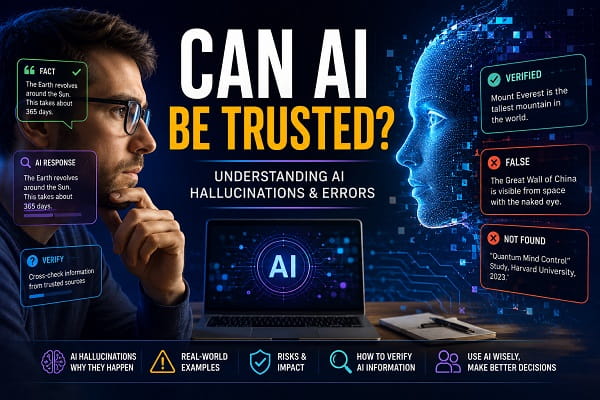
Imagine asking an AI chatbot for legal advice. Within seconds, it produces a detailed answer that sounds professional, confident, and well-researched. It even cites court cases to support its claims. Everything appears legitimate.
A few days later, however, you discover something alarming: the court cases never existed.
The citations were completely fabricated.
The AI wasn’t trying to deceive anyone. It simply generated information that sounded plausible but wasn’t actually true.
This phenomenon, known as an AI hallucination, has become one of the biggest challenges facing artificial intelligence today.
As AI systems become increasingly integrated into education, business, healthcare, cybersecurity, and everyday life, millions of people rely on them to answer questions, summarize information, generate content, and assist with important decisions. Most of the time, these systems are remarkably useful. They can save time, improve productivity, and make complex information easier to understand.
But there’s a problem.
AI can sometimes produce incorrect information with the same confidence it uses when providing accurate answers. It may invent statistics, create fake citations, misinterpret facts, or generate explanations that sound convincing but are completely wrong.
This raises an important question for students, professionals, businesses, and everyday users alike:
Can AI actually be trusted?
The answer is neither a simple yes nor a simple no.
Artificial intelligence is one of the most powerful technologies ever created, but it is not infallible. Like humans, AI systems can make mistakes. Unlike humans, however, those mistakes can be delivered instantly, at scale, and with an appearance of authority that makes them difficult to detect.
Understanding why AI hallucinations happen, how they affect real-world decisions, and how to verify AI-generated information is becoming an essential skill in the digital age.
Before deciding whether AI can be trusted, it’s important to understand how these systems work—and why even the most advanced models sometimes get things wrong.
Why Trust Matters in the AI Era
As artificial intelligence becomes more powerful and widely adopted, understanding its opportunities and limitations is increasingly important. Our guide on how to prepare for artificial intelligence explores the skills and knowledge people need to thrive in an AI-driven world.
Throughout history, people have relied on trusted sources of information. These sources include:
- Books
- Teachers
- Experts
- Journalists
- Researchers
- Institutions
When information comes from a recognized source, people naturally assume it has been verified.
Artificial intelligence changes this dynamic.
Unlike traditional sources, AI does not “know” information in the way humans do.
Instead, it predicts what words should come next based on patterns learned during training.
This distinction is important because it explains why AI can sometimes sound intelligent while being completely wrong.
As AI becomes more common, digital trust is becoming one of the most important issues in modern technology.
What Is an AI Hallucination?
An AI hallucination occurs when an artificial intelligence system generates information that is false, misleading, or completely invented.
The output may appear convincing, but it does not accurately reflect reality.
Examples include:
- Invented facts
- Fake statistics
- Fabricated quotations
- Nonexistent research papers
- Incorrect explanations
- Imaginary citations
The term “hallucination” does not mean the AI is conscious or experiencing something similar to human hallucinations.
It simply describes situations where the system produces information that has no factual basis.
Why Do AI Hallucinations Happen?
Many people assume AI systems search their memory like humans.
In reality, large language models operate differently.
They generate responses by predicting likely patterns of language.
Most of the time, this works surprisingly well.
However, problems arise when the AI encounters uncertainty.
Rather than saying “I don’t know,” the model may attempt to generate the most plausible answer possible.
This can result in:
- Partial truths
- Mixed information
- Incorrect assumptions
- Entirely fabricated content
In many cases, the AI is not intentionally producing false information.
It is simply making predictions that happen to be wrong.
The Confidence Problem
One of the biggest challenges with AI errors is confidence.
Humans often recognize uncertainty.
When people are unsure, they may hesitate, ask questions, or acknowledge limitations.
AI systems often do the opposite.
An AI can present inaccurate information with the same confidence it uses for correct information.
This makes errors particularly difficult to identify.
Consider these two responses:
Human Response
“I think that’s correct, but you should verify it.”
AI Response
“That information is correct.”
Even when the AI is mistaken, the tone may sound authoritative.
This creates a risk for users who assume confidence equals accuracy.
Real-World Examples of AI Errors
Many of today’s AI assistants are incredibly capable, but they can still make mistakes. If you’re comparing leading AI platforms, our detailed ChatGPT vs Claude review examines how two of the most popular AI systems perform in real-world tasks.
AI hallucinations are not merely theoretical concerns.
Several high-profile incidents have demonstrated the risks.
Fake Legal Citations
Lawyers have submitted court documents containing cases generated by AI that never actually existed.
The citations appeared authentic but were entirely fabricated.
Incorrect Medical Information
AI systems have occasionally provided inaccurate health advice.
This highlights the importance of professional oversight.
False Research References
Students and researchers sometimes discover that AI-generated sources cannot be found anywhere.
Business Mistakes
Organizations using AI-generated reports have occasionally encountered inaccurate data and conclusions.
These examples demonstrate why verification remains essential.
Why AI Is Still Useful Despite These Problems
At this point, some readers may wonder whether AI can be trusted at all.
The answer is yes—but with caution.
AI offers significant advantages.
Speed
AI can process information rapidly.
Productivity
Routine tasks can often be completed more efficiently.
Accessibility
Complex topics can be explained in simpler terms.
Creativity
AI can assist with brainstorming and idea generation.
Learning Support
Students can receive personalized guidance.
The goal is not to reject AI.
The goal is to use it intelligently.
Are AI Hallucinations Getting Better or Worse?
This is an interesting question.
Modern AI models are generally more accurate than earlier versions.
However, they are also more capable.
As users ask increasingly complex questions, new opportunities for errors emerge.
Several improvements are reducing hallucinations:
Better Training Methods
Developers continue improving model quality.
Human Feedback
AI systems learn from user interactions and evaluations.
Retrieval Systems
Some models can access external information sources.
Improved Reasoning
Newer systems perform more sophisticated analysis.
While hallucinations remain a challenge, researchers are actively working to reduce them.
AI vs Human Errors
Many discussions focus exclusively on AI mistakes.
However, humans also make errors.
People can:
- Misremember facts
- Misinterpret information
- Spread rumors
- Make poor decisions
- Fall for misinformation
The difference is scale.
A human mistake may affect a small audience.
An AI mistake can potentially reach millions of users.
This is why accuracy matters so much.
The goal should not be comparing humans and AI as competitors.
Instead, we should evaluate how both can complement one another.
The Risks of Blindly Trusting AI
AI-generated misinformation is becoming a major concern online, particularly as synthetic media becomes more realistic. Our guide to what are deepfakes and how AI is changing digital media explores one of the most significant examples of this challenge.
Using AI without verification can create serious problems.
Education
Students may learn incorrect information.
Healthcare
Inaccurate advice could affect important decisions.
Finance
Incorrect recommendations may result in financial losses.
Business
Poor information can lead to costly mistakes.
Journalism
False claims can spread rapidly.
These risks increase when users assume AI is always correct.
How to Verify AI-Generated Information
One of the most valuable skills in the AI era is verification.
Here are several practical strategies.
Check Multiple Sources
Compare AI responses with trusted sources.
Verify Citations
Ensure referenced studies, books, and articles actually exist.
Use Official Sources
Government agencies, universities, and reputable organizations often provide reliable information.
Ask Follow-Up Questions
Challenge the AI’s assumptions.
Be Skeptical of Extraordinary Claims
If something sounds surprising, investigate further.
Verification is becoming a critical digital literacy skill.
Can AI Be Trusted in Education?
The growing use of AI in classrooms has created both exciting opportunities and new challenges. Learn more in our article on how AI is changing education and discover how schools are adapting to AI-powered learning.
Education is one of the areas where AI is expanding rapidly.
Students use AI for:
- Research
- Study assistance
- Writing support
- Problem solving
The challenge is ensuring AI enhances learning rather than replacing critical thinking.
Students should view AI as a learning companion rather than an unquestionable authority.
The most successful learners will combine AI assistance with independent verification.
Can AI Be Trusted in Business?
Businesses increasingly rely on AI to automate tasks and improve productivity, but this transformation is also reshaping careers and industries. Read Will AI Replace Jobs? What Workers Need to Know in 2026 for a deeper look at AI’s impact on the workforce.
Businesses increasingly rely on AI for:
- Customer support
- Data analysis
- Content creation
- Automation
- Decision support
In these environments, human oversight remains essential.
AI can accelerate workflows, but final decisions often require human judgment.
Organizations that combine AI efficiency with human expertise typically achieve the best results.
The Future of AI Reliability
Researchers are investing heavily in improving trustworthiness.
Future systems may include:
Better Fact Checking
Automatic verification of claims.
Source Transparency
Clear identification of information sources.
Reduced Hallucinations
Improved model accuracy.
Specialized Expert Systems
AI models designed for specific industries.
Enhanced User Controls
Greater visibility into how answers are generated.
While perfection may never be achievable, reliability is expected to improve significantly.
The Difference Between Useful and Perfect
Many people expect AI to be either completely trustworthy or completely unreliable.
Reality lies somewhere in between.
AI does not need to be perfect to be valuable.
Search engines occasionally show inaccurate information.
Humans make mistakes.
Experts can be wrong.
The goal should be understanding limitations rather than expecting perfection.
AI is a tool.
Like any tool, its effectiveness depends on how it is used.
Trust, But Verify
Perhaps the best way to think about artificial intelligence is through a simple principle:
Trust, but verify.
AI can help people learn faster, work more efficiently, and solve problems more effectively.
However, it should not replace critical thinking.
The most successful AI users are not those who blindly accept every answer.
They are the people who ask questions, verify information, and understand when human judgment is required.
As artificial intelligence becomes increasingly embedded in everyday life, the ability to evaluate information will become one of the most valuable skills anyone can develop.
The future will not belong to people who trust AI completely.
Nor will it belong to those who reject it entirely. Instead, it will belong to those who understand both what AI can do and what it cannot.
