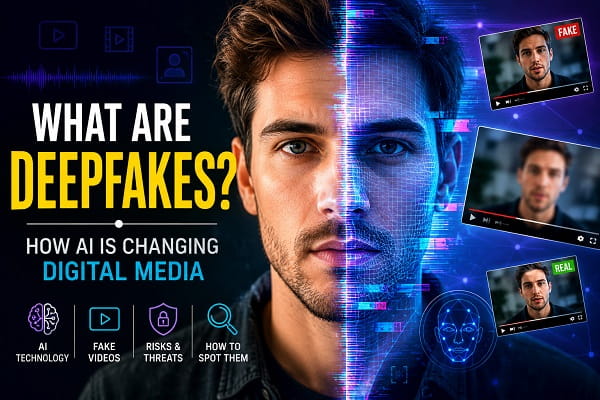
Imagine receiving a video message from your boss asking you to urgently transfer money to a specific account.
The voice sounds authentic.
The facial expressions look natural.
The person in the video appears completely real.
You follow the instructions, only to discover later that the video was entirely fake.
No actor was hired.
No camera was used.
The video was generated by artificial intelligence.
Welcome to the world of deepfakes.
Just a few years ago, creating realistic fake videos required advanced editing skills, expensive software, and countless hours of work. Today, artificial intelligence can generate highly convincing videos, voices, and images in a fraction of the time.
Some people see deepfakes as an exciting technological breakthrough.
Others view them as one of the most dangerous developments in modern media.
Both perspectives have some truth.
Deepfakes are changing how digital content is created, consumed, and trusted. They are transforming entertainment, marketing, education, and communication while also creating serious concerns about misinformation, fraud, privacy, and security.
To understand why deepfakes are becoming such an important topic, we first need to understand what they are and how they work.
What Is a Deepfake?
A deepfake is a piece of digital media that has been created or manipulated using artificial intelligence to make someone appear to say or do something they never actually said or did.
Deepfakes can take several forms:
- Fake videos
- Synthetic voices
- Altered images
- AI-generated interviews
- Virtual presenters
- Digital avatars
The term “deepfake” combines two concepts:
- Deep Learning, a branch of artificial intelligence
- Fake, referring to artificially created content
The result is media that can look remarkably authentic despite being entirely generated or heavily modified by AI.
How Deepfakes Work
The technology behind deepfakes is surprisingly complex.
At the heart of most deepfake systems are machine learning models trained on large amounts of data.
Step 1: Collecting Data
AI systems require examples to learn from.
For a deepfake video, the AI may analyze:
- Hundreds of photos
- Video clips
- Voice recordings
- Facial expressions
- Speech patterns
The more data available, the more convincing the result can become.
Step 2: Learning Facial Features
The AI studies:
- Eye movements
- Lip synchronization
- Facial structure
- Head movements
- Expressions
It learns how a person’s face behaves under different conditions.
Step 3: Generating New Content
Once trained, the system can create entirely new content that mimics the target person.
The AI predicts how the face should move, how the voice should sound, and how expressions should appear.
Step 4: Refinement
Modern AI systems continuously improve the realism of generated content.
Small imperfections that once exposed fake videos are becoming increasingly difficult to detect.
This is why deepfakes have improved so dramatically over the last few years.
Why Deepfakes Are Becoming More Realistic
The rapid improvement in deepfake technology is part of a broader wave of artificial intelligence innovation that is transforming multiple industries. If you’re new to the topic, learn how to prepare for artificial intelligence and understand the skills becoming increasingly important in the AI era.
Several technological trends are accelerating deepfake development.
More Powerful AI Models
Modern AI systems process information far more effectively than earlier generations.
Better Training Data
Social media, videos, podcasts, and online content provide enormous amounts of training material.
Faster Computing Power
Advanced hardware enables AI systems to generate media more efficiently.
Improved Generative AI
Recent breakthroughs in generative AI have dramatically improved realism.
The combination of these factors is producing content that can sometimes fool even experienced observers.
The Positive Side of Deepfake Technology
Deepfakes often receive negative attention, but the technology also has legitimate uses.
Entertainment and Film Production
Movie studios increasingly use AI-powered visual effects.
Applications include:
- De-aging actors
- Language dubbing
- Digital stunt doubles
- Historical recreations
This can reduce production costs while expanding creative possibilities.
Education and Learning
Deepfake technology can create engaging educational experiences.
Imagine:
- Historical figures explaining events
- Interactive language tutors
- Personalized learning content
These applications can make education more immersive.
Accessibility
AI-generated voices can help individuals who lose the ability to speak.
Voice cloning technology allows users to preserve their own voice patterns.
Content Localization
Companies can translate videos into multiple languages while maintaining realistic lip synchronization.
This improves communication across global audiences.
Marketing and Customer Engagement
Businesses increasingly use AI-generated presenters and virtual spokespersons.
This allows organizations to create personalized content at scale.
The technology itself is not inherently harmful.
The challenge lies in how it is used.
The Dark Side of Deepfakes
Many of the risks associated with deepfakes overlap with modern cybersecurity challenges. Our guide on AI in cybersecurity explains how artificial intelligence is being used to detect threats, prevent fraud, and improve digital security.
While deepfakes offer legitimate benefits, they also create significant risks.
Misinformation
One of the biggest concerns involves false information.
Imagine a realistic video showing:
- A politician making controversial statements
- A celebrity promoting a scam
- A public figure appearing to commit misconduct
Even if the content is fake, it can spread rapidly online.
Fraud and Financial Crime
Cybercriminals are beginning to use AI-generated voices and videos for fraud.
Examples include:
- Fake executive requests
- Business email scams
- Banking fraud
- Identity impersonation
As deepfake technology improves, these attacks may become more convincing.
Reputation Damage
Individuals can become victims of fabricated media.
False videos or audio recordings can harm careers, relationships, and reputations.
Privacy Concerns
Deepfakes raise important questions about consent.
Should someone be allowed to digitally recreate another person’s appearance or voice without permission?
Many legal systems are still struggling to answer this question.
Deepfakes and Social Media
Social media platforms have accelerated the spread of AI-generated content.
Why?
Because content spreads faster than verification.
A convincing deepfake can reach millions of viewers before fact-checkers have time to respond.
Several factors contribute to this problem:
Speed
Information moves rapidly across social networks.
Emotional Reactions
People are more likely to share content that triggers strong emotions.
Algorithmic Amplification
Popular content often receives greater visibility.
Confirmation Bias
Users sometimes believe information that supports their existing views.
These factors make deepfakes particularly challenging to manage.
Deepfake Scams Are Becoming More Sophisticated
As AI systems become more powerful, they are influencing both opportunities and risks in the workplace. Read Will AI Replace Jobs? What Workers Need to Know in 2026 to understand how AI is reshaping careers and industries.
Cybersecurity experts are increasingly concerned about AI-powered scams.
Some emerging threats include:
Voice Cloning Fraud
Attackers clone a person’s voice to deceive family members or colleagues.
CEO Impersonation
Fraudsters create convincing messages from company executives.
Fake Customer Support
AI-generated voices can mimic legitimate organizations.
Investment Scams
Deepfake videos may feature celebrities promoting fraudulent schemes.
These scams demonstrate how artificial intelligence can be used for both innovation and deception.
How to Spot a Deepfake
Identifying deepfakes is becoming more difficult, but certain warning signs may help.
Unnatural Facial Movements
Watch for unusual expressions or inconsistent eye movement.
Strange Lighting
Lighting may appear inconsistent across different parts of the image.
Audio Mismatches
Voice timing may not perfectly match mouth movements.
Unusual Details
Hands, teeth, ears, and background objects can sometimes reveal imperfections.
Emotional Inconsistencies
The person’s tone and expressions may feel unnatural.
While these clues can help, future deepfakes may eliminate many of these weaknesses.
The Technology Fighting Deepfakes
As deepfakes become more sophisticated, researchers are developing detection tools.
AI Detection Systems
AI can be used to identify AI-generated content.
Digital Watermarking
Some systems embed hidden identifiers into generated media.
Content Authentication
Verification frameworks can help confirm whether media is authentic.
Source Verification
Organizations increasingly verify content before publication.
The battle between deepfake creation and deepfake detection is becoming a technological arms race.
Can Deepfakes Influence Elections?
The growing influence of AI-generated content highlights the need for digital literacy and responsible technology use. Our article on how AI is changing education explores how schools and institutions are preparing learners for an AI-powered future.
This is one of the most debated questions in technology and politics.
A convincing fake video released at the right moment could potentially:
- Mislead voters
- Influence public opinion
- Damage trust
- Spread misinformation
Even if the content is eventually debunked, the initial impact may still be significant.
Governments, researchers, and technology companies are actively exploring ways to reduce these risks.
The Future of Deepfakes
Many of the same advances behind deepfake technology are powered by modern AI models. If you’re comparing leading AI assistants, check out our detailed ChatGPT vs Claude comparison.
Deepfake technology is still evolving.
Future developments may include:
More Realistic Videos
Generated content will continue improving in quality.
Real-Time Deepfakes
AI may modify video streams instantly during live conversations.
Personalized Digital Avatars
People may create AI versions of themselves for communication and work.
Advanced Security Challenges
Organizations will need stronger verification systems.
New Regulations
Governments may introduce laws governing AI-generated content.
The future will likely involve both remarkable opportunities and serious challenges.
Why Trust May Become the Most Valuable Resource Online
For decades, people generally assumed that photographs and videos represented reality.
That assumption is changing.
As AI-generated media becomes more convincing, simply seeing something may no longer be enough to believe it.
This doesn’t mean society should fear technology.
However, it does mean digital literacy is becoming more important.
People must learn to:
- Verify information
- Evaluate sources
- Question suspicious content
- Think critically before sharing media
The ability to distinguish fact from fiction may become one of the most important skills of the AI era.
Deepfakes are just one example of how artificial intelligence is expanding beyond traditional chatbots. Explore more innovative platforms in our guide to AI tools other than ChatGPT.
The New Reality of Digital Media
Deepfakes represent one of the most fascinating and controversial applications of artificial intelligence.
They can educate, entertain, improve accessibility, and unlock new creative possibilities.
At the same time, they can be used for deception, fraud, misinformation, and manipulation.
The technology itself is neither good nor bad.
What matters is how people choose to use it.
As artificial intelligence continues advancing, deepfakes will likely become a permanent part of the digital landscape. Understanding how they work—and how to evaluate the content we encounter online—will be essential for navigating the future of media, communication, and trust.
