
Artificial intelligence is no longer a technology of the future. It is already helping doctors analyze medical scans, assisting students with homework, detecting cyber threats, generating videos, writing content, recommending products, and making decisions that affect millions of people every day. As AI becomes more powerful, however, an important question is emerging:
Just because AI can do something, should it?
This question sits at the heart of AI ethics.
For decades, technological progress was primarily focused on making systems faster, smarter, and more efficient. Today, the conversation is changing. Researchers, governments, businesses, and ordinary users are increasingly concerned about how artificial intelligence should be developed and used.
What happens when an AI system makes a biased decision?
Who is responsible when an AI tool causes harm?
Should companies be allowed to collect massive amounts of personal data to train AI models?
How do we prevent deepfakes from spreading misinformation?
These are not theoretical questions anymore.
They are real challenges that society is already facing.
Understanding AI ethics is becoming just as important as understanding AI technology itself.
What Is AI Ethics?
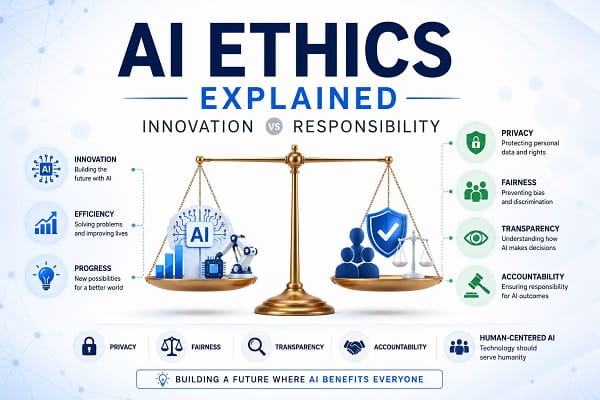
AI ethics refers to the principles, standards, and guidelines used to ensure artificial intelligence is developed and used responsibly.
The goal is not to stop innovation.
Instead, ethical AI aims to balance technological progress with human values.
AI ethics focuses on questions such as:
- Is the system fair?
- Is it transparent?
- Does it respect privacy?
- Can its decisions be explained?
- Who is accountable for mistakes?
- Does it benefit society?
These questions become increasingly important as AI systems gain more influence over daily life.
Why AI Ethics Matters More Than Ever
Understanding the ethical challenges of artificial intelligence starts with understanding how AI is changing society. Our article on how AI is changing education explores one of the most significant transformations currently taking place.
Technology has always created ethical challenges. The internet introduced concerns about privacy.
Social media raised questions about misinformation.
Artificial intelligence combines many of these challenges while adding new ones.
Unlike traditional software, AI systems can:
- Learn from data
- Make predictions
- Generate content
- Influence decisions
- Operate at massive scale
This means mistakes can spread quickly and affect large numbers of people.
A flawed AI system used by a few individuals may not seem significant.
A flawed AI system used by millions can have enormous consequences.
The Problem of Bias in AI
One of the most discussed ethical issues in artificial intelligence is bias.
Many people assume computers are objective.
Unfortunately, AI systems learn from data created by humans.
If the training data contains bias, the AI may reproduce or even amplify those biases.
How Bias Happens
Imagine an AI hiring system trained on historical employment data.
If past hiring decisions favored certain groups over others, the AI may learn those patterns and continue them.
The system isn’t intentionally discriminating.
It is simply learning from biased examples.
Real-World Consequences
Bias can affect:
- Hiring decisions
- Loan approvals
- Healthcare recommendations
- Law enforcement tools
- Educational opportunities
Because of these risks, organizations must carefully evaluate AI systems for fairness.
Privacy: The Data Dilemma
Artificial intelligence depends on data.
The more data available, the more capable many AI systems become.
This creates a difficult ethical question:
How much personal information should organizations be allowed to collect?
Modern AI systems may learn from:
- Search history
- Social media activity
- Location data
- Purchasing behavior
- Voice recordings
- Images and videos
While this information can improve AI performance, it also raises concerns about surveillance and privacy.
Many users are unaware of how much information they generate every day.
As AI becomes more sophisticated, protecting personal data becomes increasingly important.
AI Hallucinations and Misinformation
One of the biggest ethical concerns surrounding AI is reliability. Read Can AI Be Trusted? Understanding AI Hallucinations and Errors to learn why AI sometimes generates false information and how users can verify AI-generated content.
One of the biggest challenges facing AI today is reliability.
AI systems sometimes generate:
- Incorrect facts
- Fake citations
- Misleading explanations
- Fabricated information
These mistakes are often called AI hallucinations.
The problem becomes more serious when users assume AI-generated content is always accurate.
Misinformation can spread quickly when people trust technology without verification.
This is why critical thinking remains essential, even in an AI-powered world.
Deepfakes and Synthetic Media
Deepfakes have become one of the most controversial applications of artificial intelligence. Our guide on what are deepfakes and how AI is changing digital media explains how this technology works and why it raises serious ethical concerns.
Deepfake technology has become one of the most visible examples of AI ethics in action.
AI can now create:
- Realistic videos
- Synthetic voices
- Altered images
- Digital avatars
These technologies offer exciting opportunities in education, entertainment, and accessibility.
At the same time, they can be used for:
- Fraud
- Identity theft
- Political manipulation
- Misinformation campaigns
The challenge is not the technology itself.
The challenge is ensuring it is used responsibly.
Who Is Responsible When AI Makes a Mistake?
Imagine an AI-powered vehicle causes an accident.
Who should be held accountable?
Possible answers include:
- The developer
- The manufacturer
- The user
- The company operating the system
There is often no simple answer.
As AI becomes more autonomous, questions of responsibility become increasingly complex.
Legal systems around the world are still working to address these challenges.
Accountability will likely become one of the most important issues in AI governance.
The Transparency Problem
Many advanced AI systems operate as what experts call “black boxes.”
This means they can generate decisions without clearly explaining how those decisions were made.
Imagine being denied:
- A loan
- A job opportunity
- Insurance coverage
because of an AI system.
Wouldn’t you want to know why?
Transparency is important because people deserve to understand decisions that affect their lives.
The more influential AI becomes, the more important explainability becomes.
AI and Job Displacement
Concerns about automation and employment are central to modern AI ethics. Explore Will AI Replace Jobs? What Workers Need to Know in 2026 for a detailed look at how artificial intelligence is reshaping the workforce.
Few AI topics generate as much public concern as employment.
Automation has always changed labor markets.
Artificial intelligence is accelerating this process.
Some tasks that once required human workers can now be performed by AI systems.
This may affect:
- Administrative roles
- Customer support
- Content production
- Data processing
- Repetitive office work
However, AI is also creating new opportunities and professions.
The ethical challenge lies in managing the transition fairly.
Societies must consider:
- Worker retraining
- Educational reform
- Economic support
- Workforce adaptation
The goal should be helping people benefit from technological progress rather than being left behind by it.
Can AI Be Too Powerful?
Preparing for a future shaped by increasingly advanced AI systems requires both technical knowledge and adaptability. Learn how to prepare for artificial intelligence and develop skills that remain valuable in the AI era.
Some researchers worry about future AI systems becoming significantly more capable than today’s models.
These concerns include:
Loss of Human Control
Could future systems make decisions humans struggle to understand?
Concentration of Power
Could a small number of companies gain excessive influence through advanced AI?
Security Risks
Could powerful AI systems be used maliciously?
Global Competition
Could nations prioritize AI advancement over safety?
While some of these concerns remain speculative, they highlight the importance of proactive planning.
Should AI Be Regulated?
Many discussions about AI regulation involve security, privacy, and online safety. Our article on AI in cybersecurity examines how artificial intelligence is being used to fight modern digital threats.
Opinions differ on this issue.
Some people believe regulation is essential.
Others worry excessive regulation could slow innovation.
Supporters of regulation argue that rules can help:
- Protect consumers
- Improve transparency
- Prevent abuse
- Promote fairness
- Reduce harmful outcomes
Critics argue that overly restrictive regulations may limit technological progress.
Finding the right balance remains one of the biggest challenges facing policymakers.
Ethical AI in Healthcare
Healthcare demonstrates both the promise and complexity of AI ethics.
AI can help:
- Detect diseases
- Analyze medical images
- Predict health risks
- Improve efficiency
These benefits have the potential to save lives.
However, concerns remain regarding:
- Patient privacy
- Data security
- Bias in medical recommendations
- Accountability for errors
Healthcare decisions often involve human lives, making ethical considerations especially important.
Ethical AI in Education
Educational institutions increasingly use AI for:
- Personalized learning
- Student assessment
- Administrative support
- Educational content generation
These innovations can improve learning experiences.
However, educators must also consider:
- Student privacy
- Academic integrity
- Digital literacy
- Equal access to technology
The challenge is ensuring AI enhances education without undermining critical thinking and human development.
The Future of AI Ethics
AI ethics will likely become even more important in the coming years.
Future discussions may focus on:
- Global AI standards
- International regulations
- AI accountability frameworks
- Transparency requirements
- Digital rights
- Human oversight systems
As AI capabilities expand, ethical questions will become increasingly complex.
The decisions made today may shape how artificial intelligence affects society for decades.
Why Ethics Cannot Be an Afterthought
One of the biggest mistakes organizations can make is treating ethics as something to address later.
Ethical considerations should be integrated into AI development from the beginning.
Building responsible AI is often easier than fixing harmful systems after they have already been deployed.
The most successful AI technologies will likely be those that combine innovation with responsibility.
Artificial intelligence extends far beyond ethics discussions and powers a growing ecosystem of tools and applications. Explore some of the most popular platforms in our guide to AI tools other than ChatGPT.
The Human Side of Artificial Intelligence
Despite all the technical discussions surrounding artificial intelligence, AI ethics is ultimately about people.
It is about ensuring technology serves humanity rather than the other way around.
Questions about fairness, privacy, accountability, trust, and transparency are not merely technical issues.
They are human issues.
Artificial intelligence has the potential to improve lives, solve complex problems, and create extraordinary opportunities.
But achieving those benefits requires thoughtful decision-making, responsible development, and ongoing oversight.
The future of AI will not be determined solely by what technology can accomplish. It will also be determined by the values society chooses to prioritize as that technology continues to evolve.
