
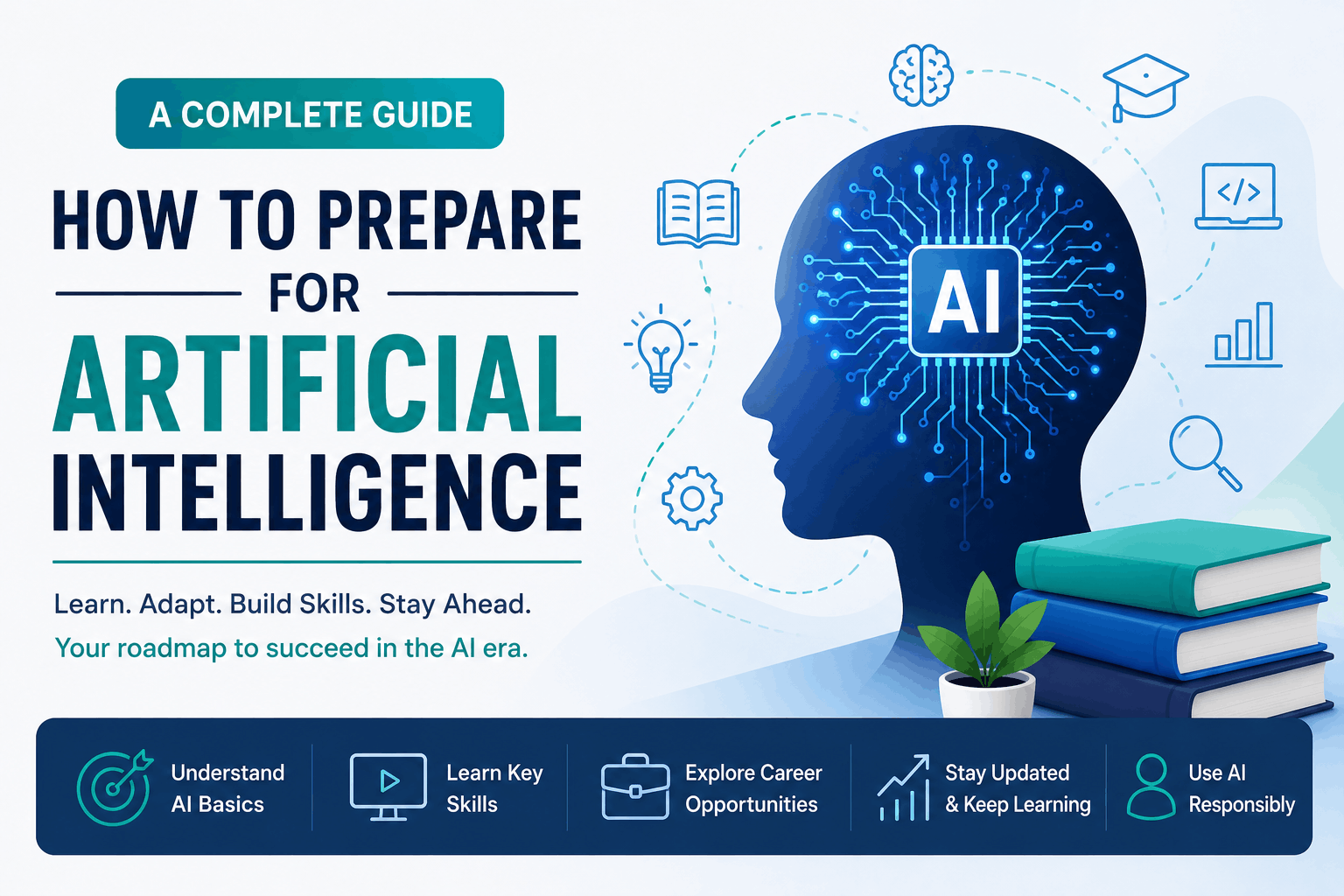
Artificial intelligence is no longer a futuristic concept. It is already transforming how people work, learn, communicate, shop, create content, and solve problems. From virtual assistants and chatbots to self-driving vehicles and advanced business automation, AI is becoming a major part of everyday life.
As AI continues to evolve, many people are asking an important question:
How can I prepare for artificial intelligence?
Whether you’re a student, job seeker, entrepreneur, freelancer, or working professional, preparing for AI can help you remain competitive in a rapidly changing world.
The good news is that you don’t need to become a machine learning engineer or data scientist to benefit from artificial intelligence. Understanding how AI works, learning how to use AI tools effectively, and developing future-proof skills can help you thrive in the years ahead.
In this guide, you’ll learn practical ways to prepare for artificial intelligence and position yourself for success in the AI-driven future.
Why Artificial Intelligence Matters
Artificial intelligence is changing industries at an unprecedented pace.
Today, AI is being used in:
- Healthcare
- Education
- Marketing
- Finance
- Manufacturing
- Customer service
- Software development
- Content creation
Companies are increasingly adopting AI to improve productivity, reduce costs, and automate repetitive tasks.
According to many industry experts, AI will continue to influence nearly every profession over the next decade.
Rather than viewing AI as a threat, it’s often more productive to see it as a powerful tool that can enhance human capabilities.
Understand What Artificial Intelligence Really Is
One of the first steps in preparing for AI is understanding what it actually means.
Artificial intelligence refers to computer systems that can perform tasks typically requiring human intelligence.
Examples include:
- Language understanding
- Image recognition
- Decision-making
- Pattern detection
- Problem solving
- Voice recognition
Modern AI tools can generate text, create images, summarize documents, answer questions, and automate workflows.
However, AI is not magic.
It relies on data, algorithms, and computing power to perform specific tasks.
Understanding this helps reduce fear and misinformation about the technology.
Learn How AI Is Already Being Used
Getting familiar with practical AI applications is one of the easiest ways to prepare for the future. If you’re just starting out, our guide on the best AI tools for students without sign up introduces beginner-friendly tools that can help with studying, research, writing, and productivity.
You probably interact with AI every day without realizing it.
Examples include:
- Search engines
- Recommendation systems
- Navigation apps
- Voice assistants
- Social media feeds
- Online shopping suggestions
Learning how businesses use AI can help you identify opportunities within your own field.
Spend time exploring real-world AI applications and understanding how they improve efficiency and productivity.
Develop Digital Skills
Strong digital literacy is becoming increasingly important.
You don’t need advanced technical expertise, but you should be comfortable with:
- Online collaboration tools
- Cloud platforms
- Productivity software
- Digital communication
- Data management
People who adapt quickly to new technologies often have an advantage in AI-driven workplaces.
Learn to Use Popular AI Tools
One of the most effective ways to prepare for artificial intelligence is to start using AI tools today.
Popular examples include:
ChatGPT
Useful for:
- Writing assistance
- Research
- Brainstorming
- Learning new topics
Gemini
Helpful for productivity, information gathering, and content creation.
Perplexity AI
Excellent for research and source-based answers.
Notion AI
Useful for organization, note-taking, and project management.
Canva AI
Helpful for presentations, graphics, and design projects.
The more familiar you become with AI tools, the easier it will be to adapt as technology evolves.
Focus on Skills That AI Cannot Easily Replace
One of the best ways to understand artificial intelligence is by exploring the tools already available today. Our article on AI tools other than ChatGPT highlights powerful platforms that can help with content creation, research, design, and everyday productivity tasks.
While AI is powerful, certain human abilities remain highly valuable.
These include:
Critical Thinking
AI can provide information, but humans must evaluate and interpret it.
Creativity
Original ideas, storytelling, innovation, and artistic expression remain important.
Emotional Intelligence
Empathy, communication, and relationship-building are difficult to automate.
Leadership
Organizations still need people who can guide teams and make strategic decisions.
Problem Solving
Complex real-world problems often require human judgment and adaptability.
Developing these skills can help future-proof your career.
Learn Basic Data Literacy
Data is the foundation of artificial intelligence.
You don’t need to become a data scientist, but understanding basic concepts can be helpful.
Learn about:
- Data collection
- Data analysis
- Statistics
- Data visualization
Many free online courses can teach these fundamentals.
Consider Learning Programming
Programming is not mandatory for everyone, but it can be beneficial.
Languages commonly associated with AI include:
Python
The most popular language for AI and machine learning.
SQL
Useful for working with databases.
JavaScript
Helpful for web-based AI applications.
Even basic coding knowledge can improve your understanding of technology.
Stay Updated on AI Developments
Artificial intelligence evolves rapidly.
To stay informed:
- Follow technology news
- Read AI blogs
- Watch educational videos
- Listen to technology podcasts
- Join online communities
Continuous learning is one of the most valuable skills in the AI era.
Build an AI-Friendly Career Mindset
Preparing for AI is not just about technology.
It also involves adopting the right mindset.
Successful individuals tend to:
- Embrace change
- Learn continuously
- Adapt quickly
- Experiment with new tools
- Remain curious
Instead of resisting technological change, focus on understanding and leveraging it.
How Students Can Prepare for Artificial Intelligence
Students who embrace AI early often gain a significant advantage when it comes to learning and productivity. For a deeper look at educational AI platforms, explore our roundup of AI study tools that help you learn faster.
Students have a unique opportunity to prepare early.
Recommended actions include:
Learn AI Fundamentals
Explore beginner-friendly AI courses and tutorials.
Use AI Responsibly
Use AI to enhance learning rather than replace it.
Improve Research Skills
AI can assist with research, but critical evaluation remains important.
Build Digital Competence
Become comfortable using modern productivity tools.
Develop Soft Skills
Communication, teamwork, and creativity remain highly valuable.
How Professionals Can Prepare for Artificial Intelligence
Modern workplaces increasingly rely on AI-powered productivity tools to improve efficiency and organization. If you want to stay competitive in an AI-driven workplace, check out our guide to the best AI note-taking apps for students and professionals.
Working professionals can benefit from AI by improving productivity and expanding their skill sets.
Practical steps include:
Automate Routine Tasks
Identify repetitive tasks that AI can simplify.
Learn Industry-Specific AI Applications
Different industries use AI differently.
Upskill Regularly
Invest in ongoing professional development.
Collaborate With AI
View AI as a productivity partner rather than a competitor.
How Businesses Can Prepare for Artificial Intelligence
Businesses should develop a proactive AI strategy.
This may include:
- Employee training
- Workflow automation
- Data management improvements
- AI tool adoption
- Ethical AI practices
Organizations that adapt effectively may gain a competitive advantage.
Common Myths About Artificial Intelligence
AI Will Replace Every Job
While some tasks may become automated, new roles and opportunities will also emerge.
AI Is Only for Programmers
Many AI tools are designed for non-technical users.
You Need Advanced Math to Use AI
Most people can benefit from AI without studying advanced mathematics.
AI Is Perfect
AI systems can make mistakes and should always be used critically.
Frequently Asked Questions
Do I need to learn coding to prepare for AI?
No. While coding can be helpful, many people successfully use AI tools without programming knowledge.
What skills are most important in an AI-driven future?
Critical thinking, creativity, communication, emotional intelligence, and adaptability remain highly valuable.
Can AI help students learn more effectively?
Yes. AI can assist with research, note-taking, tutoring, and productivity.
Is it too late to start learning about AI?
Not at all. Artificial intelligence is still evolving, and there are many opportunities to learn and adapt.
Understanding artificial intelligence is not just about theory. It’s also about learning how AI can improve real-world tasks such as creating presentations, summarizing documents, and managing information. Our guide to free AI presentation maker tools demonstrates how AI can automate and simplify everyday work.
Final Thoughts
Artificial intelligence is reshaping the world, but preparing for it doesn’t require becoming a technology expert.
The most effective approach is to understand the basics, learn how to use AI tools responsibly, develop valuable human skills, and commit to continuous learning.
Whether you’re a student planning your future, a professional looking to remain competitive, or a business owner exploring new opportunities, preparing for artificial intelligence today can help you succeed in tomorrow’s economy.
The people who thrive in the AI era will not necessarily be those who know the most about technology. They will be the ones who remain adaptable, curious, and willing to learn as the world continues to evolve.
