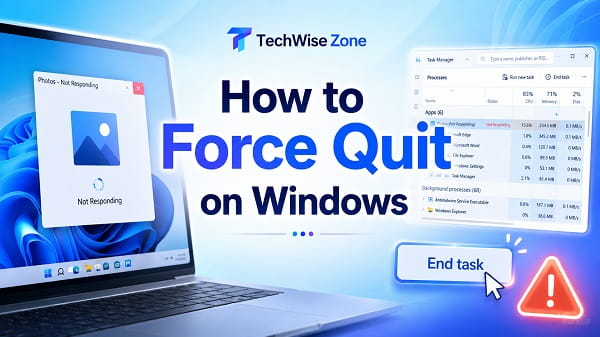
When an app freezes and refuses to close, knowing how to force quit on Windows can save you from restarting the entire computer. Windows provides several ways to close an unresponsive program, from simple keyboard shortcuts to Task Manager, the Windows 11 taskbar, Command Prompt, and PowerShell.
The best method depends on how badly the app is frozen. If the program still responds to keyboard input, Alt + F4 may close it normally. If it is completely stuck, Task Manager > End task is usually the fastest solution. Windows 11 also has an optional End Task command that can appear when you right-click an app on the taskbar, and advanced users can terminate a process with taskkill or PowerShell.
Force quitting can cause unsaved work in the affected app to be lost, so I recommend trying a normal close first whenever possible.
Quick Answer: How to Force Quit on Windows
If you need the fastest method:
- Press Ctrl + Shift + Esc to open Task Manager.
- Find the frozen app under Processes.
- Select the app.
- Click End task.
If Task Manager does not appear, press:
Ctrl + Alt + Deleteand choose Task Manager.
For an app that is still partially responsive, try:
Alt + F4first.
On supported Windows 11 versions, you can also enable an End Task option for taskbar icons and close frozen apps without opening Task Manager.
What Does Force Quit Mean on Windows?
“Force quit” is a phrase many people know from macOS, but the same idea applies to Windows.
On Windows, force quitting means terminating an application or process that will not close normally.
You may need to force close an app when:
- The window says Not Responding
- Clicking the X button does nothing
- The app is frozen
- The program is using excessive CPU or memory
- A full-screen game will not close
- A background process continues running after the window disappears
- An app prevents another program or installer from opening
- Windows says a file is still in use
- The program has become stuck during shutdown
Some methods politely ask the application to close, while others terminate the process directly. That distinction matters because a forced termination can discard unsaved data.
Method 1: Press Alt + F4
The simplest way to close the active program is:
Alt + F4Microsoft documents Alt + F4 as the Windows shortcut for closing the active item or exiting the active app.
To use it:
- Click the frozen app so it is the active window.
- Press Alt + F4.
- Wait a moment.
If the app still has enough functionality to respond to Windows, it may close.
Is Alt + F4 Really a Force Quit?
Not always.
Alt + F4 normally sends the application’s standard close command. It is closer to clicking the X button than forcibly killing a process.
That makes it a good first step because the app may still have a chance to save data, ask whether you want to save, close files properly, and release resources normally.
If Alt + F4 does nothing, move to Task Manager.
Alt + F4 Does Not Work
If the shortcut does not respond:
- Make sure the frozen window is selected
- Try the other Alt key
- On some laptops, try Fn + Alt + F4
- Confirm the keyboard itself is working
- Open Task Manager with Ctrl + Shift + Esc
If several keyboard shortcuts are failing, there may be a keyboard or Windows input issue rather than just a frozen application.
Method 2: Force Quit With Task Manager
Task Manager is the method I recommend most often because it is built into Windows and lets you see exactly which app you are terminating.
Press:
Ctrl + Shift + EscMicrosoft documents this shortcut as a direct way to open Task Manager.
Then:
- Open Processes if Task Manager does not already show it.
- Find the frozen application.
- Select it.
- Click End task.
Windows should terminate the app.
Microsoft describes Task Manager as a Windows system tool that can terminate unresponsive programs, and Microsoft’s own troubleshooting instructions use End task to close applications that stop responding.
What If the App Is Listed More Than Once?
Some applications use multiple processes. Examples include Chrome, Microsoft Edge, Discord, Teams, creative applications, and game launchers.
If the main application entry is grouped, selecting the top-level app and choosing End task will often terminate the relevant processes.
Do not randomly end unfamiliar Windows processes. If you are unsure what a process does, leave it alone and identify it before terminating it.
Method 3: Use Ctrl + Alt + Delete
If Task Manager will not open with Ctrl + Shift + Esc, use:
Ctrl + Alt + DeleteThis takes you to the Windows security screen.
Select:
Task Manager
Then find the frozen app and choose End task.
Microsoft documents Ctrl + Alt + Delete as the shortcut that opens the Windows security screen, where Task Manager is one of the available options.
This method can be useful when the desktop is sluggish, the Start menu is not responding, the taskbar is frozen, or a full-screen app is covering everything.
If Ctrl + Alt + Delete itself does not work, see Ctrl Alt Delete Not Working? How to Fix It for the dedicated troubleshooting steps.
Method 4: Enable End Task on the Windows 11 Taskbar
Current Windows 11 versions include an optional End Task command that can be added to the taskbar context menu.
Once enabled, you can right-click a running app on the taskbar and force-close it without opening Task Manager.
On current Windows 11 builds, open:
Settings > System > Advanced
Then find the For developers section and enable:
End Task
On some Windows 11 versions, the developer settings may appear directly under:
Settings > System > For developers
After enabling the option:
- Find the frozen app’s icon on the taskbar.
- Right-click it.
- Choose End task.
Microsoft’s current Windows advanced-settings documentation describes this option as enabling End task when right-clicking an app on the taskbar.
Why This Method Is Useful
This is one of the quickest ways to force quit on Windows 11 because you do not need to open Task Manager, search through a process list, or remember a process name.
It is particularly useful if you frequently test software, games, browsers, or programs that occasionally freeze.
What If End Task Is Missing?
If right-clicking the taskbar icon does not show End task:
- Open Windows Settings.
- Search Settings for End Task or For developers.
- Make sure the taskbar End Task setting is enabled.
- Install current Windows updates.
- Restart Windows if necessary.
The feature may not appear in exactly the same location on every Windows 11 build because Microsoft has reorganized some advanced settings over time.
Method 5: Force Quit From Command Prompt With taskkill
If Task Manager cannot terminate the app, Windows includes the taskkill command.
Microsoft documents taskkill as a command that can end one or more processes by process ID or image name.
Open Windows Terminal (Admin) or Command Prompt (Admin).
First run:
tasklistThe tasklist command displays the currently running processes.
Look for the app’s executable name, such as:
notepad.exeForce Quit by Process Name
Run:
taskkill /F /IM notepad.exeReplace notepad.exe with the actual process you want to terminate.
The options mean:
/Fforces termination/IMidentifies the process by image name
Force Quit by PID
You can also terminate the app by process ID:
taskkill /F /PID 1234Replace 1234 with the actual PID shown on your computer.
Close the Process and Its Child Processes
For applications that launch related child processes, use:
taskkill /F /T /IM example.exeThe /T option ends the specified process and child processes started by it.
Use this carefully. Do not run taskkill against Windows system processes unless you understand the consequences.
Method 6: Force Quit With PowerShell
PowerShell provides another built-in method.
Open Windows Terminal and choose a PowerShell tab.
Microsoft documents the Stop-Process cmdlet for terminating running processes by process name or PID.
To view processes:
Get-ProcessTo stop an app by name:
Stop-Process -Name notepadTo force it:
Stop-Process -Name notepad -ForceTo stop a process by PID:
Stop-Process -Id 1234 -ForceReplace 1234 with the process ID.
Some processes owned by another user or protected by Windows may require PowerShell to be opened as administrator.
taskkill vs Stop-Process
Use taskkill if you are comfortable with Command Prompt, know the executable name, or want to include child processes with /T.
Use Stop-Process if you prefer PowerShell or are already working with Get-Process.
For an ordinary frozen application, Task Manager is still easier.
Method 7: Sign Out or Restart Windows
Sometimes an application becomes so stuck that Task Manager cannot terminate it, command-line tools return an error, or the desktop becomes unstable.
At that point, signing out or restarting Windows may be the cleanest solution.
Press:
Ctrl + Alt + Deleteand select Sign out, or use:
Start > Power > Restart
Signing out closes applications running under your user session. Restarting reloads the whole Windows environment.
Both can cause unsaved work to be lost.
Last Resort: Forced Power Off
If the entire PC is frozen and the mouse does not move, Ctrl + Alt + Delete does nothing, Task Manager cannot open, and Windows cannot restart normally, you may need to hold the physical power button until the computer turns off.
Use this only as a last resort because a forced shutdown can interrupt writes, lose unsaved data, or interfere with updates.
How to Force Quit a Full-Screen Game on Windows
Games can be harder to close because they may capture the display and keyboard.
Try these methods in order:
- Press Alt + F4.
- Press Ctrl + Shift + Esc.
- Use Alt + Tab to switch to Task Manager if necessary.
- Select the game and choose End task.
- If that fails, press Ctrl + Alt + Delete and open Task Manager.
- As an advanced fallback, use
taskkillwith the game’s executable name.
If the game keeps freezing, force quitting is only a temporary recovery step. Repeated crashes may point to GPU drivers, game files, overlays, RAM instability, or background software.
How to Force Quit a Browser on Windows
If Chrome, Edge, Firefox, or another browser freezes:
- Press Ctrl + Shift + Esc.
- Find the browser.
- Select it.
- Click End task.
Browsers commonly run multiple processes, so Task Manager may show several entries.
Force closing the browser can cause unsaved form data, downloads, private sessions, or web-app work to be lost.
If the browser is freezing because of memory problems, see Error Code: Out of Memory in Chrome or Edge? How to Fix It.
How to Force Quit File Explorer
File Explorer is different from an ordinary application because explorer.exe also controls parts of the Windows desktop and taskbar.
If File Explorer freezes, do not treat it exactly like a normal app.
Open Task Manager:
Ctrl + Shift + EscFind:
Windows Explorer
Then choose Restart task or Restart, depending on the Task Manager interface.
Restarting Explorer can recover:
- A frozen taskbar
- File Explorer windows
- Desktop icons
- Some shell problems
For more options, see How to Restart File Explorer in Windows 11.
How to Force Quit an App Without Task Manager
If you do not want to use Task Manager, the best alternatives are:
Alt + F4
Alt + F4Best when the app still responds enough to process a normal close request.
Windows 11 Taskbar End Task
Enable End Task in Windows advanced or developer settings, then right-click the taskbar app and choose:
End task
Command Prompt
taskkill /F /IM app.exePowerShell
Stop-Process -Name app -ForceThese methods are useful if Task Manager itself is unavailable.
How to Find the Process Name of an App
If you want to use taskkill or PowerShell but do not know the process name, use one of these methods.
Task Manager
Open Task Manager and locate the application.
The Details section can show executable names such as:
chrome.exe
discord.exe
notepad.exe
Command Prompt
Run:
tasklistPowerShell
Run:
Get-ProcessMatch the process to the app you want to close.
Do not guess when terminating an unfamiliar process.
What Is the Difference Between Close and End Task?
A normal close gives the application a chance to shut down properly.
Examples include:
- Clicking the X
- Choosing File > Exit
- Alt + F4
The program can save information, ask whether you want to save, stop background tasks, and release resources normally.
End task terminates the application more aggressively.
That makes it useful when the normal close request has failed.
The tradeoff is that the program may not be able to save unsaved work.
What Is the Difference Between End Task and End Process?
The terminology varies depending on which Windows tool you are using.
In Task Manager, End task terminates the selected application or process.
Command-line tools operate directly on processes.
For example:
taskkill /F /PID 1234forces the specified process to terminate.
For ordinary users, the important distinction is whether you are closing an app normally or terminating its underlying process because it will not respond.
What Is End Process Tree?
Some programs start other processes.
A process tree consists of a parent process and processes launched beneath it.
The taskkill command can end a process tree with:
taskkill /F /T /PID 1234or:
taskkill /F /T /IM example.exeThis can be useful when terminating only the parent leaves helper processes running.
However, it is more aggressive than ending one process.
Use it only when you have identified the program correctly.
Why Won’t Windows Let Me End a Task?
Sometimes Windows displays:
Access is deniedor the process immediately returns.
Possible reasons include:
- The process is running with administrator privileges
- It belongs to another user
- It is a protected Windows process
- A service automatically restarts it
- The app has several processes
- Security software is protecting the process
- The process is part of Windows itself
Try opening Task Manager, Command Prompt, or PowerShell as administrator only if the process genuinely requires elevation.
Do not attempt to force-kill protected Windows processes simply to make them disappear.
What If Task Manager Is Not Responding?
Task Manager itself can occasionally freeze.
Try closing and reopening it.
You can also use Command Prompt:
tasklistthen:
taskkill /F /IM example.exeor use PowerShell:
Get-Processand:
Stop-Process -Name example -ForceIf Windows system tools are repeatedly freezing, restart Windows and investigate broader system problems.
What If the App Keeps Freezing After I Force Quit It?
Force quitting solves the immediate problem, but it does not fix the underlying cause.
If the app repeatedly becomes unresponsive:
- Restart Windows.
- Update the application.
- Install Windows updates.
- Check the app’s repair or reset options.
- Update relevant drivers.
- Disable problematic plugins or extensions.
- Check CPU, memory, and disk usage.
- Reinstall the application if necessary.
- Test in Safe Mode or a clean boot if multiple programs freeze.
If the application works in Safe Mode but freezes during normal startup, a background program or service may be interfering.
See How to Boot Windows 11 in Safe Mode for the available startup methods.
Can Force Quitting Damage an App?
Force quitting does not normally damage an application installation.
The bigger risk is losing unsaved data.
Problems are more likely if you terminate an application while it is:
- Saving a document
- Updating
- Installing software
- Writing a database
- Updating firmware
- Modifying important files
Avoid forcing an app to close during a critical write or update unless there is no safe alternative.
Can I Force Quit Windows Update?
I do not recommend terminating Windows Update processes manually.
Interrupting Windows while it is installing system updates can create failed updates, boot problems, or corrupted system components.
If Windows Update appears stuck, troubleshoot Windows Update rather than randomly ending update services or processes.
Can I Force Quit Antivirus Software?
Avoid terminating antivirus and endpoint-security processes unless you have a specific reason and understand the consequences.
Many security processes are protected and Windows may block attempts to stop them.
Use the software’s own controls or uninstall process rather than trying to kill its background components.
Can I Force Quit an App From the Run Dialog?
There is no simple Run command that automatically knows which foreground app you want to close.
However, you can use Run to open Task Manager.
Press:
Windows + RType:
taskmgrand press Enter.
You can also launch Command Prompt with:
cmdand use the taskkill commands explained earlier.
Best Force Quit Method for Most Users
For most situations, use this order:
- Try Alt + F4.
- Press Ctrl + Shift + Esc.
- Select the frozen app in Task Manager.
- Click End task.
- If Task Manager does not open, use Ctrl + Alt + Delete.
- On Windows 11, enable the taskbar End Task option for easier future access.
- Use
taskkillor PowerShell only when the graphical methods fail. - Restart Windows if the entire system is unstable.
This order starts with the least destructive method and moves toward more forceful process termination only when necessary.
Frequently Asked Questions
How do I force quit on Windows?
Press Ctrl + Shift + Esc, select the frozen app in Task Manager, and click End task.
You can also enable the Windows 11 taskbar End Task option or use taskkill from Command Prompt.
What is the Windows equivalent of Force Quit on Mac?
The closest Windows equivalent is:
Task Manager > End task
Open Task Manager with:
Ctrl + Shift + EscWhat keyboard shortcut force quits an app on Windows?
Windows does not have one universal shortcut that forcibly terminates the active process in the same way Task Manager’s End task does.
Alt + F4 closes the active app, but it normally sends a standard close request.
For a truly frozen app, use:
Ctrl + Shift + Escand choose End task.
How do I force quit on Windows 11?
The quickest method is Task Manager:
Ctrl + Shift + EscSelect the app and click End task.
Windows 11 also has an optional taskbar End Task command that can be enabled in advanced or developer settings.
How do I force close a program without Task Manager?
Use one of these:
Alt + F4or Command Prompt:
taskkill /F /IM app.exeor PowerShell:
Stop-Process -Name app -ForceWindows 11 users can also enable End Task on the taskbar.
How do I force quit a program that says Not Responding?
Open Task Manager with Ctrl + Shift + Esc, find the Not Responding application, select it, and click End task.
How do I force quit a full-screen application?
Try Alt + F4 first.
If that fails, press Ctrl + Shift + Esc or Ctrl + Alt + Delete, open Task Manager, select the program, and click End task.
What is the taskkill command?
taskkill is a built-in Windows command for ending running processes by executable name or process ID.
Example:
taskkill /F /IM notepad.exeHow do I kill a process by PID in Windows?
Run:
taskkill /F /PID 1234Replace 1234 with the actual PID.
How do I force quit with PowerShell?
Run:
Stop-Process -Name notepad -Forceor terminate a specific PID:
Stop-Process -Id 1234 -ForceWill force quitting delete my files?
It will not normally delete existing files, but unsaved work inside the terminated application may be lost.
Is it safe to force quit a frozen app?
Usually, yes, when the application is genuinely unresponsive.
Try a normal close first. Avoid force quitting software while it is installing updates, writing important files, or updating firmware.
Why does my app reopen after I end the task?
A background service, launcher, updater, or Windows startup component may automatically restart it.
Check the application’s settings and Task Manager to identify what is relaunching the process.
Can I force quit Windows Explorer?
Yes, but restarting Windows Explorer through Task Manager is usually better than simply terminating it because Explorer controls the desktop, taskbar, and File Explorer interface.
Use the Least Forceful Method That Works
Knowing how to force quit on Windows is useful whenever a program freezes, but you do not need to jump immediately to command-line process termination.
Start with Alt + F4. If the app is truly unresponsive, open Task Manager with Ctrl + Shift + Esc and use End task. Windows 11 users can make this even faster by enabling the taskbar End Task command.
Use taskkill and PowerShell when you need more direct control over a process, and restart Windows when the problem affects more than one application.
If the same program keeps freezing, treat force quitting as a temporary recovery step and troubleshoot why the application is becoming unresponsive.
